Visiting Tuol Sleng (S-21) and the Choeung Ek Killing Fields in Phnom Penh: A Firsthand Guide
My visit of Tuol Sleng S-21 and the Choeung Ek Killing Fields

This post covers genocide, torture, and mass murder. I wrote it for educational purposes and kept the most graphic details out.
I spent a day in Phnom Penh visiting two of the most sobering places in Southeast Asia: Tuol Sleng Genocide Museum, better known as Security Prison 21 (S-21), and the Choeung Ek Killing Fields.
This guide walks through both in the order I saw them, with some historical context up front so the sites make more sense. It is heavy material, but I think it is worth the time if you are visiting Cambodia.
Background: How the Khmer Rouge Came to Power
Cambodia was a French protectorate until it gained independence in 1953, and it became a constitutional monarchy under King Norodom Sihanouk. He was not just a figurehead. He held real political power, and that lasted until 1970, when he traveled abroad and was overthrown in a military coup led by Lon Nol. The country then became the Khmer Republic.
Pol Pot, the leader of the Khmer Rouge, got his start in communist circles in Paris, where he was part of a Marxist group of Cambodian students. He admired both the Chinese and Stalinist models of communism. After the coup, the exiled Sihanouk threw his support behind the Khmer Rouge, which gave the movement far more legitimacy.
Add the American bombing of Cambodia during those years, plus widespread resentment and low morale under the Lon Nol government, and the conditions were set for a civil war. With backing from China and the exiled king, the Khmer Rouge won, and they entered Phnom Penh on April 17, 1975.
What followed was a radical experiment. The Khmer Rouge declared "Year Zero," emptied the cities, abolished money, and tried to force the country into a purely agrarian society. Educated people and city dwellers were treated as enemies of the state. Paranoia, fear of dissent, and an obsession with ideological purity drove the creation of a network of prisons across the country, close to 200 of them. S-21 was the most notorious.
Cambodian history is fascinating and heartbreaking, and I recommend setting aside 30 minutes to read up on it before your visit.
Part 1: Tuol Sleng Genocide Museum (S-21)
Getting in
The entrance fee was $10 when I visited: $5 for the ticket and $5 for the audio guide. You can also use your phone to look things up as you go, but I highly recommend the audio guide. It adds a lot of detail at each stop.
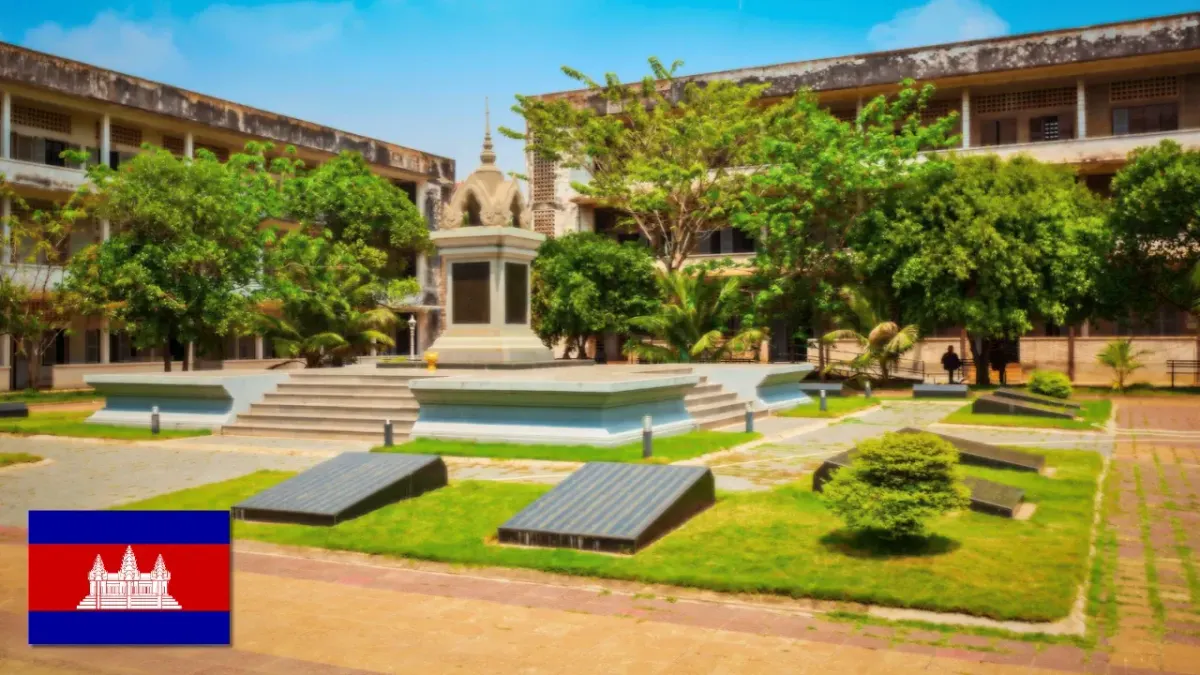
What makes this place so unsettling is how ordinary it looks. S-21 was a high school (Tuol Svay Prey High School) before the Khmer Rouge converted it into a prison, and the buildings still look like school buildings.
The courtyard and the rules
Right inside the entrance are 14 gravestones. They mark the last 14 prisoners to die here. When Vietnamese forces and Cambodian allies closed in on Phnom Penh in January 1979, the guards killed the remaining prisoners before fleeing. According to the audio guide, they used blades and clubs instead of guns so the approaching forces would not hear gunshots.
In the main courtyard next to the graves, you will find the prison rules that detainees were forced to follow. In short: answer questions immediately and exactly, never make excuses or pretend to be ignorant, do not scream or cry while being whipped or shocked, stay silent unless ordered to speak, and do not use pretexts to hide your secrets or betrayals. Breaking the rules meant lashes or electric shocks.
Building A
Building A has three floors divided into 20 cells. The ground floor held the cells used to jail, interrogate, and torture prisoners who had once been high officials. The upper floors have larger cells used for the same purpose. The walls carry very graphic photographs showing what happened here, including prisoners chained and electrocuted. Many of the rooms also display the names and ages of detainees. These are only examples, since many thousands passed through over the years.
The audio guide explained how S-21 was set up in 1975. Son Sen, a senior member of the Communist Party of Kampuchea in charge of military affairs, ordered two cadres to establish it. The prison was one of several locations in the S-21 system, and the "S" stands for security. The audio guide also gave an explanation for the number 21, which I found interesting, though sources vary on the origin of the name.
Between the buildings
The courtyard between Building A and Building B was once the playground. If you have been to a school in Southeast Asia, you can picture it: open space, exercise bars, shade trees. The Khmer Rouge turned it into a gallows and torture area. The graves in this courtyard sit right where students used to play.
Building B
Building B holds much of the museum's photographic history. I saw portraits of the Khmer Rouge leaders, including Pol Pot and Duch, whose real name is Kaing Guek Eav. Duch ran S-21.
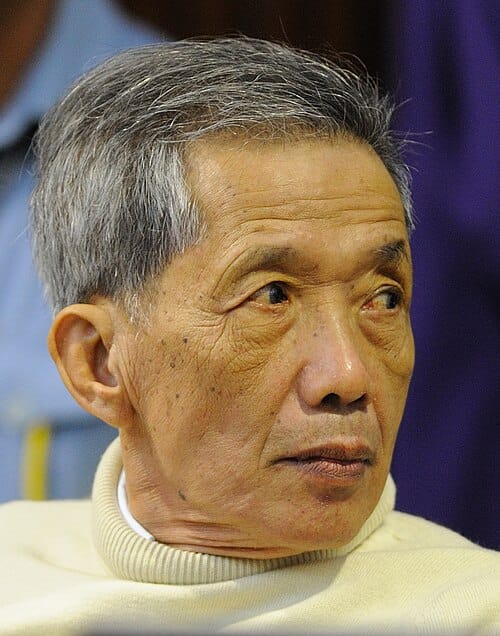
He had overseen another prison before this one and refined his methods for extracting confessions. The process was simple and brutal: obtain the confession, add the prisoner to the "smash list," and send them to the killing fields. "Smash" was the Khmer Rouge's own word for it.
One detail that stood out to me: Pol Pot is wearing glasses in his portrait, while ordinary Cambodians could be labeled enemies of the state simply for wearing them, since glasses were seen as a sign of being an intellectual.
As the regime grew more paranoid, it turned on its own people. There is a photo of a former minister of commerce, Koy Thuon, who ended up as a prisoner at S-21. Another display shows Khmer Rouge cadres in their black uniforms and matching hats.
Many were in their early twenties or even children, indoctrinated into the ideology, and some of them later became prisoners as well. There are also displays about the forced evacuation of Phnom Penh in 1975, when the whole population was pushed into the countryside.
The exhibits on the prisoner system show how dehumanization worked. In 1975 prisoners had no tags or names. In 1976 they began to be given numbers, and by 1978 the system used numbers consistently. Prisoners were referred to only by number until the moment of execution. Other displays cover intellectuals who were imprisoned, including professors and doctors, along with their families. One man's long confession is displayed alongside his file.
A section on foreign nationals tells the story of Kerry Hamill and John Dewhirst. They were sailing and drifted into Cambodian waters, where they were detained and sent to S-21. Within a couple of months they were killed and their bodies burned. Under torture, prisoners gave confessions full of names that any Westerner would recognize as ridiculous. Kerry Hamill's brother, Rob, later testified at the 2009 trial of Duch before the Khmer Rouge tribunal, and Duch was convicted and sentenced to life in prison.
One exhibit shows the living conditions: people piled together and chained to each other by number. I saw the iron bars used to shackle people by the ankle. There were different sizes for different ankles, short bars that locked two people together, and long bars that locked a row of eight. Prisoners had to ask permission to lie down, to sit up, and were forbidden to speak to one another. There are also statues of Pol Pot made for propaganda purposes.
The third floor of Building B has a proper museum, with an overview of the exhibition, a map of Phnom Penh, and background on what the school was like before it became a prison. It also tells the story of a man who wrote a few books and was appointed to work at a railway station, then was arrested and sent to S-21, followed by his whole family.
Building C
Building C is the one that stays with you. The ground floor holds single cells made of brick. The upper floors have single cells made of wood, plus larger rooms for mass detention. Barbed wire strung across the balconies prevented desperate prisoners from taking their own lives. There are holes punched through the walls so guards could see into neighboring rooms more easily.
One cell is marked with the number 20. It belonged to one of the very few survivors, who is believed to be Chum Mey. He described how guards put a rope around his neck and led him in like cattle. They spared him once they learned he could repair things, typewriters in particular. Standing in that exact cell was a moment I will not forget. It is also incredibly hot and humid in there, which adds to the oppressive feeling.
Building D
Building D is the most graphic, and I only showed the first room in the video. It holds more of the horrors, along with the tools and instruments used here. One of them is a measuring device. Everyone who arrived was measured and photographed, and the famous photos you see around the museum come from this process. One photo shows the wife of a military commander who was arrested; her child was taken from her and killed.
There is also a display of remains believed to be some of the earliest victims of the prison. S-21 was killing so many people that it ran out of room for the bodies, and that is one reason the killing pits at Choeung Ek were developed.
Wrapping up S-21
When you finish, there is a small gift shop, and a memorial with plaques bearing the names of people who suffered and died here. Overall the place is very heavy, similar in tone to the War Remnants Museum in Ho Chi Minh City. I arrived around 10:30 and left around 1:00, so plan on roughly two and a half to three hours.
S-21 is a must-see
It is a confronting look at what human beings are capable of. It reminded me of the book Ordinary Men by Christopher Browning, which describes how ordinary police officers became killers one step at a time. People are capable of incredible compassion, and they are also capable of terrible cruelty.
I also found myself enjoying Phnom Penh far more than I expected. The last time I was here was around 2014, and my original opinion of Cambodia was that it was fine but I could not see myself living here. That has changed. Phnom Penh and Siem Reap are about ten times better than on my first trip. Phnom Penh is a nice, manageable city that reminds me a bit of Bangkok decades ago, and it also has some of the feel of Ho Chi Minh City.
Part 2: Choeung Ek Killing Fields
Getting there
I arranged a tuk tuk through my hotel for around 3:00 PM. The ride takes about 30 to 40 minutes since Choeung Ek is outside the city. You can also take Grab, but I found it more convenient to have the driver wait while I explored. Entry was $6, and the audio guide is included.
By the entrance there is a sign asking visitors to show respect to the millions who were killed under the genocidal Pol Pot regime. That sets the tone for the visit.
The truck stop and the holding shack
The first stops explain how prisoners from S-21 arrived. After their confessions were taken and reviewed and their names added to the smash list, they were trucked here.
Each truck carried 20 to 30 blindfolded, silent prisoners, who were led directly to the pits or held in a nearby wooden shack. The shack was not a real detention center. So many people were being killed that the executions piled up, and prisoners waited there overnight.
The mass graves
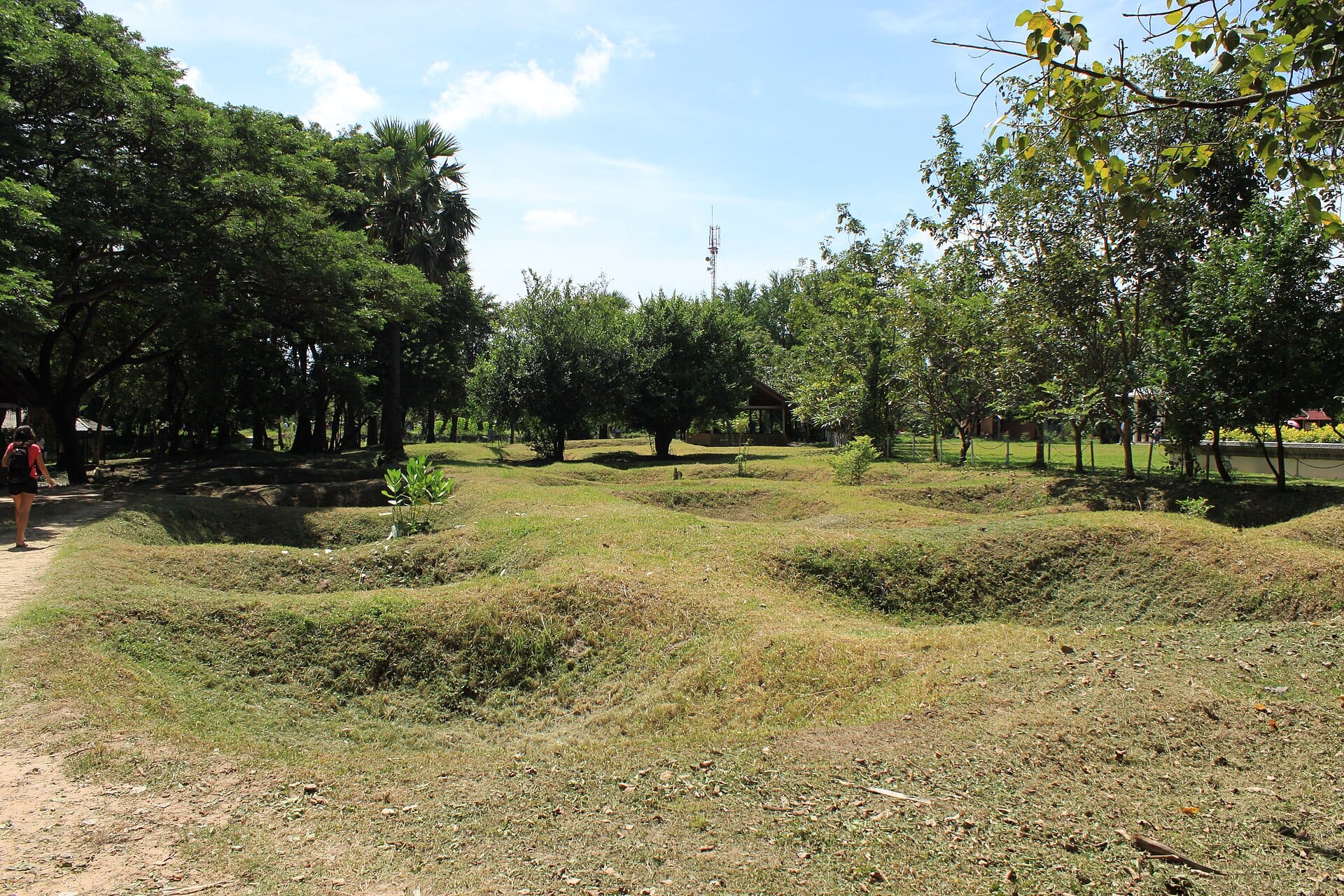
One of the first mass graves uncovered here held 450 victims. Visitors are asked to stay on the paths. The Khmer Rouge did not use bullets for most executions because they wanted to save ammunition. Victims were clubbed to death or had their throats cut with whatever tools were on hand. It is horrific, and it came about simply because prisons like S-21 were filling up.
The numbers are staggering. An estimated 1.5 to 2 million people died under the Khmer Rouge, roughly a quarter of Cambodia's population, in under four years.
You will also see skeletal remains collected from the mass graves. The ground here was a Chinese-Cambodian cemetery before 1975, and the Khmer Rouge turned it into a killing site.
The tree and the loudspeakers
The audio at one tree describes how women, children, and babies were killed. The executioners held infants by the legs and killed them against the tree. The Khmer Rouge's logic was to eliminate entire families so no one could seek revenge later. It is similar to how North Korea punishes families across generations.
Nearby is the so-called magic tree, which was used to hang loudspeakers. Propaganda music was blasted at night during the executions to cover the sounds of the victims. The audio guide describes how strange and terrifying that must have been.
You can also see pieces of bone and clothing that continue to surface after the excavations that began in 1980.
The memorial stupa
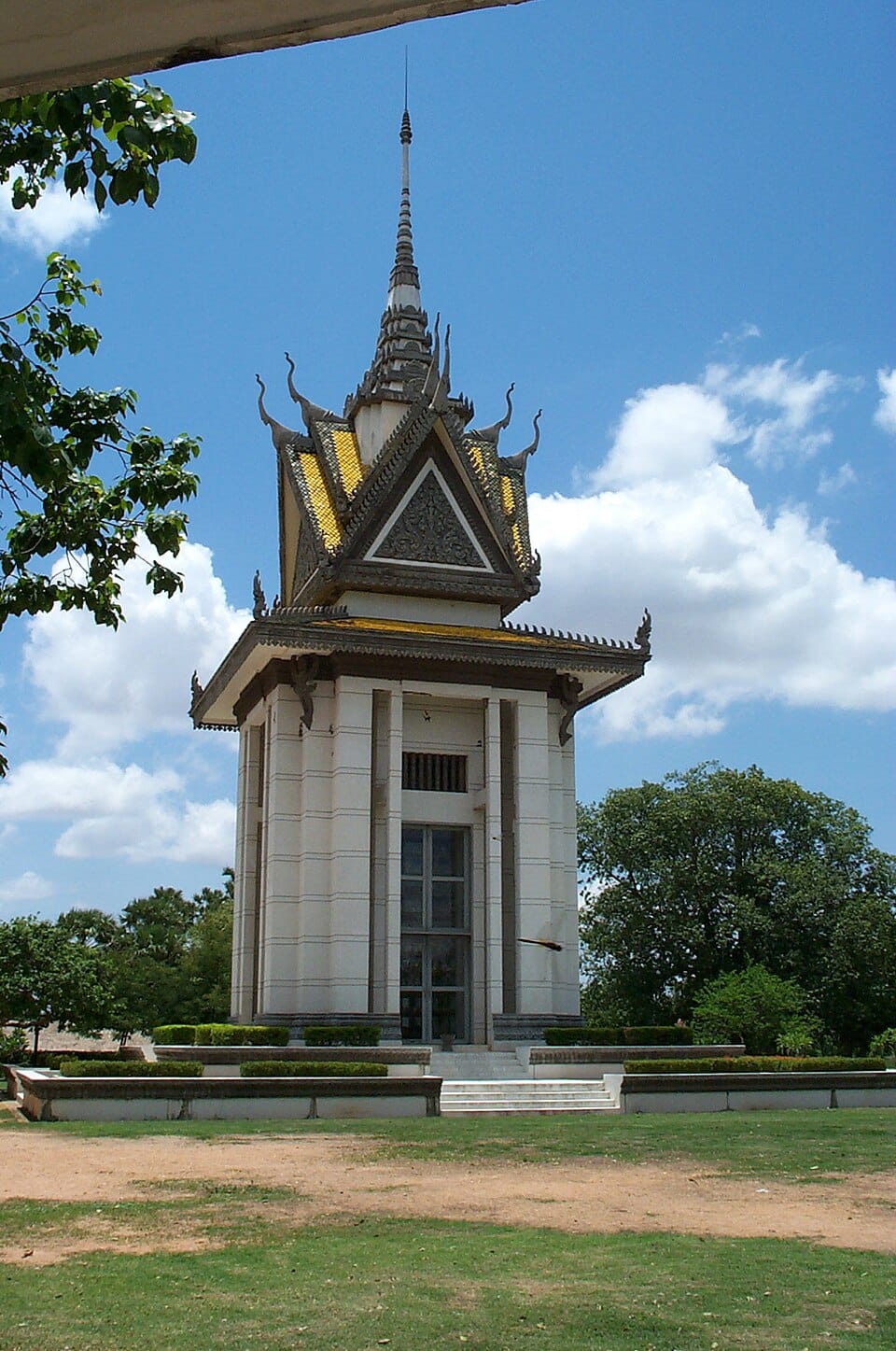
The memorial stupa was built in 1988 to preserve the remains and honor the victims. It has 17 tiers. The ground floor holds the victims' clothing, the first through ninth tiers hold skulls, and the tenth through seventeenth hold other bones, including collarbones and jawbones.
The design includes garudas on the corners and dragons, and the symbolism is meaningful: stupas are traditionally built to hold sacred remains. You can leave a flower for 2,000 riel. Video does not do this place justice. It was a deeply moving thing to see in person.
On the way out, a statue carries a message that Cambodians will never forget the crimes committed during the Democratic Kampuchea regime.
Which Site Should You Visit?
If you only have time for one, make it S-21. It is easy to reach from central Phnom Penh, and it gives you the full story of how the system worked. But I would encourage you to make the extra effort to see Choeung Ek as well. S-21 can take up to three hours, while about an hour is enough at Choeung Ek.
Practical Tips
- Budget: Around $10 for S-21 (ticket plus audio guide) and around $6 for Choeung Ek, plus transport. Check current prices before you go.
- Time: Plan 2.5 to 3 hours at S-21 and about an hour at Choeung Ek.
- Transport: A hotel-arranged tuk tuk that waits for you is the easiest way to get to Choeung Ek. Grab also works.
- Heat: Bring water and take breaks. The humidity is intense, especially inside the cell blocks.
- Respect: Dress modestly, keep your voice down, and stay on the marked paths.
- Pace yourself: Consider doing S-21 in the morning and the killing fields in the afternoon, with a break in between, as I did.
Thanks for reading. If I got any details wrong, please let me know.
Reading/Audio books I suggest checking out:
- Survival in the Killing Fields by Haing Ngor, a survivor’s firsthand account.
- First They Killed My Father by Loung Ung, the story of a child during the Khmer Rouge years.
- The Man Who Stole the Gods by Matthew Campbell, on what happened to Cambodia’s cultural heritage during and after those years.